
 German (DE)
  English (US)
  Spanish (ES)
  French (FR)
  Hindi (IN)
  Italian (IT)
  Russian (RU)
  1 hour ago
Most Americans feel unease or alarm about the climate crisis and, in both red and blue states, want to know how political leaders are going to fix it. But in midterm election campaigns across the US, candidates have responded to this desire with near silence.
People in the US have this year endured a record hot summer as well as soaring costs, equating to roughly $2,000 per household, in extra energy and mortgage payments, due to the country’s dependence on a fossil fuel supply scrambled by Donald Trump’s decision to attack Iran.
Yet the unfolding climate crisis, and the imperative to transition to cleaner, less volatile forms of energy, has been starkly absent on campaign trails before the midterms in three weeks’ time. Even among previously pro-green Democrats, 2026 has seen a widespread climate omerta.
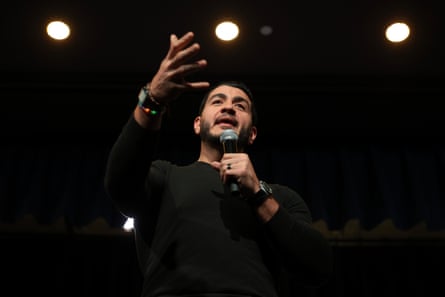
“Look, I’m not going to defend the Green New Deal,” Abdul El-Sayed, the Democratic US Senate candidate in Michigan, told Fox News in August, after previously campaigning for 100% renewable energy.
Jon Ossoff, seeking to retain his Senate seat in Georgia, has ditched mentions of the environment in favor of focusing on the Iran war and inflation. Meanwhile, James Talarico, another leading Democratic Senate hope who previously compared oil and gas to 1980s cassette tapes that are “not gonna last”, has struck a very different tone in this campaign.
“I support our oil and gas industry,” Talarico, aiming for a first Democratic win in Texas in decades, said last month. “I had family members who worked in the industry. I went to public schools here in Texas, funded by the oil and gas industry.”
Among all Democratic and Republican candidates in eight battleground states that will determine control of the US Senate – Alaska, Georgia, Maine, Iowa, Michigan, North Carolina, Ohio and Texas – none mention “climate” on their campaign websites other than El-Sayed and Talarico.
This so-called “climate hushing”, however, is disconnected from what voters actually want, polling suggests. Three times as many voters in these eight swing states want politicians to spend more time talking about the climate crisis than those who want to hear less about it, a large survey from last month found, with thumping majorities in each state saying they are more likely to vote for a candidate who prioritizes a transition to clean energy.
“The climate hushers are dead wrong – voters want to hear more about climate change, not less, and they will reward politicians who are strong climate leaders,” said Nathaniel Stinnett, executive director of the Environmental Voter Project, which conducted the poll. “Politicians should always tailor their message to their district but it’s pure fiction to say that talking about climate change will lose you votes.”
“In fact, it’s a huge vote-winner, even with independents in red states who favor fairly aggressive climate action by a four-to-one margin,” Stinnett added. “There’s this idea that climate has become a curse word and you shouldn’t say it. That’s just wrong.”
Midterm candidates may have disparaged or ignored climate action in search of electability, but the data indicates a mainstream position among US voters is concern about climate change and support for a prompt switch away from fossil fuels. More Americans are starting to link their rising living costs with fossil fuels and climate-driven disasters, too, despite a dwindling interest in political and media circles to mention such connections.
“The norm has shifted, yet so many politicians seem stuck in a 1990s world where clean energy and climate change are radical, fringe things that only environmentalists think about,” said Anthony Leiserowitz, an expert in climate communication at Yale University.
“This climate-hushing strategy, which has been adopted by many politicians, is not a logical response to where voters are,” he added. Yale’s own polling has found a majority of Americans remain worried about global heating despite the electoral success of Donald Trump, who has called climate science “a hoax”.
This is the case even in major oil and gas producing states: in the Environmental Voter Project polling released last month, 54% of voters in Texas said they’d be more likely to vote for a pro-renewables candidate, compared with 19% who said they’d be less likely, with more Texans more favorable of solar and wind energy than oil.
Despite this, Republicans have sought to paint Talarico as an eco-extremist bent on shutting down the oil and gas industry, with Ken Paxton, the scandal-plagued GOP candidate, calling his opponent “Tofu Talarico” and an enemy of the fossil fuel sector.
“In Texas, he talks about: ‘I’m a vaygan [sic], I’m a vaygan.’ He’s a vaygan meaning he likes lettuce,” Trump said about Talarico at a rally this month, with the president mis-pronouncing the word “vegan” (Talarico is not a vegan). “And now he goes to every barbecue available. He then throws up immediately after eating the steak. Throwing up all over the place.”
In Alaska, there is even stronger support for renewables, with 63% of voters saying they’d back a campaign that prioritizes the transition to clean energy. Mary Peltola, the Democratic US Senate candidate in Alaska who has run on a tagline of “fish, family, freedom”, has called for the return of tax credits for clean energy but also demands more oil be refined in the state and has pushed for the approval of a large oil project in the Alaskan Arctic.
“Increasing Alaska energy production is critical to addressing the affordability crisis, and Mary will aggressively advocate for every solution on the table – including increased oil and gas production, as well as restoring tax credits for solar, wind and hydropower projects that were cut by Dan Sullivan,” said a Peltola spokesperson, referencing her Republican opponent, who voted with other GOP lawmakers to gut Joe Biden-era legislation to boost renewables.
The Trump administration, which has moved to eliminate any limits on greenhouse gas pollution while bolstering the fossil fuel industry, considers the climate issue to be in full retreat. “You don’t hear the word ‘climate change’ as much as you did two years ago, because the legs have been knocked out from under that movement,” Doug Burgum, the interior secretary, claimed last week.
Media mentions of the climate crisis have dropped in the past year and the issue has slipped down the list of voters’ stated priorities as inflation has taken its toll and alarm over the Iran war and the state of US democracy has surged. Candidates faced with limited cash and fractured voter attention spans have found it expedient to focus on these headline topics, rather than global heating.
Attitudes towards the climate crisis also continue to differ sharply by party affiliation, with Democrats still overwhelmingly the most concerned about the issue and Republicans far more likely to see it as a trivial or even non-existent problem. This has spurred many Democrats running in states previously won by Trump to bury any mention of climate, although some have bucked this strategy.
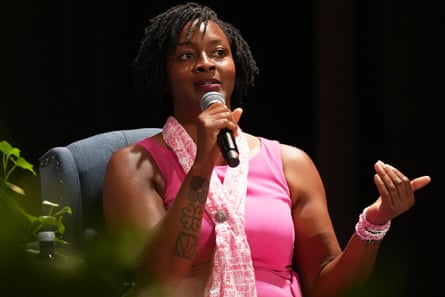
“Voters are concerned about the climate. Sometimes people just don’t understand how it impacts the cost of things like insurance, which is unfortunate,” said Angie Nixon, a Democrat running a surprisingly competitive US Senate race in Florida, which has become a Republican stronghold in recent years.
Nixon has, unlike most other candidates from both parties, repeatedly mentioned her state’s vulnerability to the climate crisis during her campaign.
“A lot of Florida will be under water in the next few decades and I’m worried about that,” she said. “I want the world to be around for my kids. Young people really care about climate change because they know it will really affect them.”
Democrats have long had a “weak” message on the climate crisis because they simply repeat back to voters what polls tell them the most pressing issues are, the Democratic senator and climate advocate Sheldon Whitehouse has argued. His party should instead actively raise and weaponize the climate crisis, Whitehouse insists, much like how Republicans do for far more niche topics, such as trans people playing sports.
“This is a story with villains – the greedy fossil fuel companies wrecking the planet and sticking Americans with the bill for the damage,” Whitehouse said. “Frustrated voters are hungry to see politicians really fighting for them, and the climate fight presents a real opportunity to show them that we are.”
But for the growing cohort of Americans who have had their lives upended by extreme events such as storms, floods and wildfires – by one estimate, this includes about a third of all people in the US over the previous two years – there is scant evidence of a fight being waged on their behalf to stem the rising temperatures that worsen such calamities.
At a meeting of disaster survivors in Kerrville, Texas, last week, several people who endured deadly flash floods that swept through the region last year – killing 136 people, including 28 of whom were at a riverside Christian camp for girls – expressed frustration that politicians have tuned out of their plight.
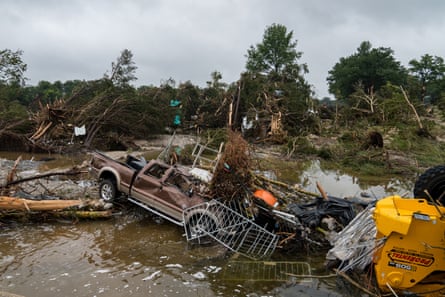
“I think that a lot of politicians couldn’t be bothered, they couldn’t be bothered by it,” said Georgia Bishop, an 18-year-old whose best friend, Felicity Jarmon, died in the floods. “They see it, they know it, they’ve heard us scream to the rooftops about it. But it just seems to be: ‘Well, this is weather, this is life.’”
A developing El Niño climate event, already one of the strongest ever recorded, is set to further accelerate extreme heat and flooding risk in parts of the US in the coming months. Bishop said at this point she wouldn’t be surprised to see a snowstorm in Texas in July. The political indifference to this is, she added, “infuriating”.
The Republican and Democratic Senate candidates from the key eight battleground states – Alaska, Georgia, Maine, Iowa, Michigan, North Carolina, Ohio and Texas – were all contacted for comment about their stance, or lack of it, on the climate crisis.











Comments