
 German (DE)
  English (US)
  Spanish (ES)
  French (FR)
  Hindi (IN)
  Italian (IT)
  Russian (RU)
  2 weeks ago
Karl MercerBBC London political editor

 BBC
BBC
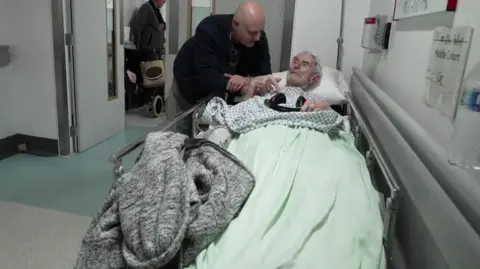
Roy Mitchell, accompanied by son Cliff, was among the many patients experiencing "corridor care" when the BBC visited Queen's Hospital
Matthew Trainer thinks this is the hardest winter he can remember.
He's the chief executive of Barking Havering and Redbridge University Hospitals Trust - and says the number of people coming through the front doors is at a record high.
The trust's two east London emergency departments, at Queen's Hospital in Romford and King George Hospital in Ilford, had their busiest ever December, with close to 1,000 patients needing treatment every day.
As we walk through the emergency department at Queen's, 51 patients are being treated on trolleys in corridors.
This is the third winter of so-called "corridor care" at the hospital. Hallways have been adapted with new plugs, sinks and emergency alarms to help cope with demand, but Trainer is open about the toll it takes.
"Corridor care is the thing causes me the greatest distress as the chief executive of the hospital and as a human being with parents and family members.
"I hope I never get to the stage when I walk through those corridors and don't feel upset about it, because I'd be concerned about my loss of compassion in the face of that. It is a horrible thing to see.
"It isn't acceptable to keep someone waiting in a corridor overnight on a trolley."
Trainer has asked the government for £35m to build a new emergency department at Queen's Hospital.
The Royal College of Nursing has said corridor care has become "entrenched" throughout England's hospitals.

Matthew Trainer says the level of treatment conducted in corridors is "heartbreaking"
Asked whether that description - "entrenched" - applies to his trust, Trainer is cautious.
"It's difficult because it implies almost that we're starting to accept it and we're not.
"Our third winter of corridor care is a horrible place to be in."
He says the staff come in to work around the clock to care for patients in the most dignified and respectful way they can.
"I know from the messages I get from patients and their families they recognise the efforts the staff are putting in."
On the day of our visit, we met Cliff Mitchell at 14:00 GMT, who was there with his elderly father Roy.
Roy had been on a trolley in the corridor since 18:00 the previous evening.
As his father prepares to leave following treatment, Cliff describes the scene around him.
"There's people everywhere, it looks like organised chaos to me.
"The staff shouldn't be working in these conditions, patients shouldn't be treated like this in corridors.
"I couldn't even stand next to my father because there's no space… I'm sure everyone is struggling with their loved ones.
"People shouldn't be on the corridor. They should be on a ward."
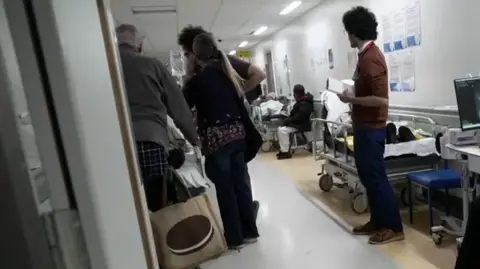
Queen's Hospital is experiencing its "hardest" winter, its chief executive said.
Ruth Green, director of nursing in the emergency department, echoed the frustration.
"Every year I think it can't get any worse, but this has been really, really hard.
"Lots of patients, long waits to be seen and a long time waiting in the emergency department.
"Just very, very hard for patients, relatives and staff."
Pressure is also felt elsewhere at Queen's Hospital.
Around 7,000 babies were born in its maternity unit last year, roughly 600 every month.
It is the third busiest unit in the country, with 400 midwives, and was given a 'good' rating by the Care Quality Commission last December.
The latest arrival came just hours before our visit.

First-time-father Sonny said the treatment his partner and newborn received was "absolutely fine"
New parents Holly Chilvers and Sonny Butler are still absorbing the arrival of their eight-hour-old son Landon, who came more quickly than expected.
"I was like 'I'm sorry I have to get him out' and boom, 14 minutes and he was out, first baby," Holly says.
"It's been absolutely fine, perfect," Sonny adds.
"It was a shock, definitely, when he first came out. I was struggling to hold him but the lady showed me how to do it."
Maternity unit head Kathryn Tompsett says the service has been looking at how to deliver care in the "most efficient way" amid almost constant NHS budget pressures.
Efficiency, she adds, is also "often the best care for women and their families".
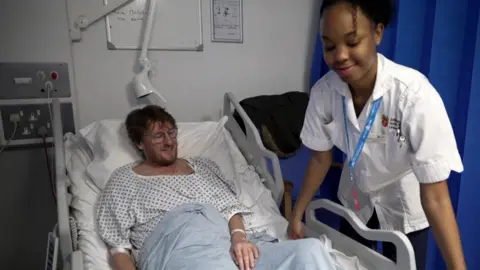
Stuart Ayris, a former nurse, was pleased with the waiting time on his knee surgery
At the trust's sister hospital in Ilford, another approach to easing pressure is under way.
King George Hospital is home to the Elective Surgical Hub, a unit of nine operating theatres dedicated solely to planned operations. By separating them from emergency work, the trust hopes they are less likely to be disrupted.
More than 10,000 planned operations were carried out at the hub last year, helping to reduce waiting lists.
Former nurse Stuart Ayris was preparing for knee replacement surgery when we met him. He said he had been impressed by how quickly his operation was arranged.
"I've been playing cricket for the last 12 years. I've got a terrible batting average, so I hope that improves," he tells us.
The operation was led by orthopaedic consultant Sivakumar Shankar, assisted by a robot, one of only a handful in the capital.
"It helps us to decide what the right implant should be based on detailed imaging of the patient," he explains.
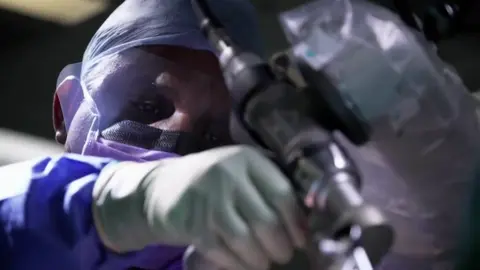
Consultant Sivakumar Shankar says surgical technology is helping deliver better outcomes
"I tell the robot what to do and then it does it. It helps us get the operation even more accurate."
As the team drilled and shaped the bone to fit the replacement, the technology offered a glimpse of progress in a system under strain.
Some challenges at Queen's and King George are being addressed.
Others, including the long-running reliance on corridor care, remain a work in progress.
While Trainer's £35m bid for a new emergency department could ease pressure at Queen's Hospital, he says the deeper challenge lies elsewhere: finding ways to stop so many people needing to come to hospital in the first place.











Comments